
Knowledge Base


-


A Premier Alkaloid: Nicotine and the Strategy for Developing Its Determination Method
Nicotine analysis is notoriously challenging due to its weak retention on conventional columns. This article shares a practical UHPLC-MS method using the Welch Ultisil HILIC Amphion II column, detailing the development approach, chromatographic conditions, and key advantages for reliable nicotine detection. -
![[Readers Insight] Matrix Effects in Mass Spectrometry: Why They Matter](//www.welch-us.com/cdn/shop/articles/matrix-effect-2-1080-922_535x.jpg?v=1773718626)
![[Readers Insight] Matrix Effects in Mass Spectrometry: Why They Matter](//www.welch-us.com/cdn/shop/articles/matrix-effect-2-1080-922_345x345@2x.jpg?v=1773718626)
[Readers Insight] Matrix Effects in Mass Spectrometry: Why They Matter
In this article, we explore further how matrix effects affects recovery results in mass spectrometry analyses by hindering preparation loss, and discuss when it should be corrected by using calibration curves prepared by blank matrices. -


Determination of Mannitol Related Substances with Xtimate Sugar-Ca
Mannitol is a substance with important applications in pharmaceutical and food. See how Welch Xtimate Sugar-Ca columns perform well in determination of mannitol related substances in accordance with Chinese Pharmacopoeia 2025 Edition. -
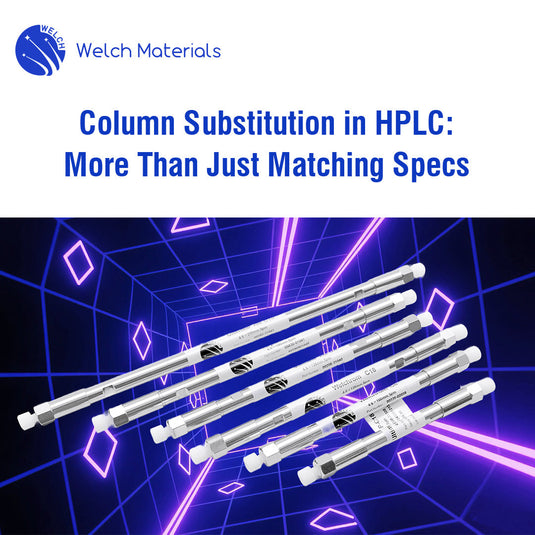

Column Substitution in HPLC: More Than Just Matching Specs
When considering HPLC column replacements, cross-reference charts can only tell half the story. Read to learn how a right Welch Column goes beyond replacement—delivering optimized results tailored to your method. -
![[Readers Insight] Acidic or Basic? Read Analyte Structure First When Developing a Method](//www.welch-us.com/cdn/shop/articles/acidic-basic0911-1080_535x.jpg?v=1773718531)
![[Readers Insight] Acidic or Basic? Read Analyte Structure First When Developing a Method](//www.welch-us.com/cdn/shop/articles/acidic-basic0911-1080_345x345@2x.jpg?v=1773718531)
[Readers Insight] Acidic or Basic? Read Analyte Structure First When Developing a Method
In this article, we discuss how to read molecular structure to assess an analyte’s acidic or basic character and use that insight to design starting chromatographic methods. You will find practical, rule-based criteria, clear decision points for method setup, and a focused real-world example that illustrates structure-driven choices. -


The Four Pillars of Welch Materials ODS Columns
This article explores the fundamental qualities of ODS columns and examines four representative designs from Welch Materials. It reflects on long-standing misconceptions, practical challenges, and design considerations, offering chromatographers deeper insight into one of the most widely used tools in liquid chromatography. -
![[Readers Insight] The Starting Point in Method Development](//www.welch-us.com/cdn/shop/articles/starting-point-1080-822_66049d9e-9b96-49f0-b38f-d3efbb05bbb0_535x.jpg?v=1773718422)
![[Readers Insight] The Starting Point in Method Development](//www.welch-us.com/cdn/shop/articles/starting-point-1080-822_66049d9e-9b96-49f0-b38f-d3efbb05bbb0_345x345@2x.jpg?v=1773718422)
[Readers Insight] The Starting Point in Method Development
Method development often begins with uncertainty—especially when faced with unknown compounds and no literature guidance. This article examines a pharmacopoeial method as a case study, highlighting its chromatographic settings, analyzing potential limitations, and considering improvements. Through this, readers gain insight into the logical framework behind choosing starting conditions. -
![[Readers Insight] Are You Choosing the Right Quantifier Ion for Mass Spectrometry?](//www.welch-us.com/cdn/shop/articles/quantifier-ion-1080-815_535x.jpg?v=1773718320)
![[Readers Insight] Are You Choosing the Right Quantifier Ion for Mass Spectrometry?](//www.welch-us.com/cdn/shop/articles/quantifier-ion-1080-815_345x345@2x.jpg?v=1773718320)
[Readers Insight] Are You Choosing the Right Quantifier Ion for Mass Spectrometry?
In this article, the author discusses the principles behind selecting quantifier ions in triple quadrupole mass spectrometry, with a case study to illustrate how ion choice impacts sensitivity and accuracy. -
![[Readers Insight] Become an “Engineer”, Instead of an “Inspector”](//www.welch-us.com/cdn/shop/articles/engineer-1080-815_86849ee0-0b0f-42aa-bbc0-466b0754ef77_535x.jpg?v=1760000922)
![[Readers Insight] Become an “Engineer”, Instead of an “Inspector”](//www.welch-us.com/cdn/shop/articles/engineer-1080-815_86849ee0-0b0f-42aa-bbc0-466b0754ef77_345x345@2x.jpg?v=1760000922)
[Readers Insight] Become an “Engineer”, Instead of an “Inspector”
In this article, we dive into a lab analyst's journey from routine tester to engineer. It emphasizes asking “why”, seeking mentorship, designing experiments, iterative troubleshooting, and developing chromatographic expertise through persistent method development. The narrative offers practical encouragement for analysts aiming to deepen theoretical understanding, solve complex problems, and advance professionally. -
![[Readers Insight] Why Do M-Shaped Peaks Occur?](//www.welch-us.com/cdn/shop/articles/m-peak-1080-814_535x.webp?v=1773651099)
![[Readers Insight] Why Do M-Shaped Peaks Occur?](//www.welch-us.com/cdn/shop/articles/m-peak-1080-814_345x345@2x.webp?v=1773651099)
[Readers Insight] Why Do M-Shaped Peaks Occur?
M-shaped peaks can puzzle even experienced chromatographers, appearing unexpectedly and resisting simple fixes. This article draws on expert insights to explore their possible origins and practical approaches, guiding analysts toward more reliable and consistent chromatographic results. -


Agarose: A Versatile Packing Material for Protein Purification
Agarose-based chromatographic media offer a compelling blend of biocompatibility, versatility, and affordability. By mastering the principles of agarose microsphere preparation and crosslinking, chromatographers can tailor supports to a vast array of protein purification challenges, ensuring high yield, purity, and process robustness. -
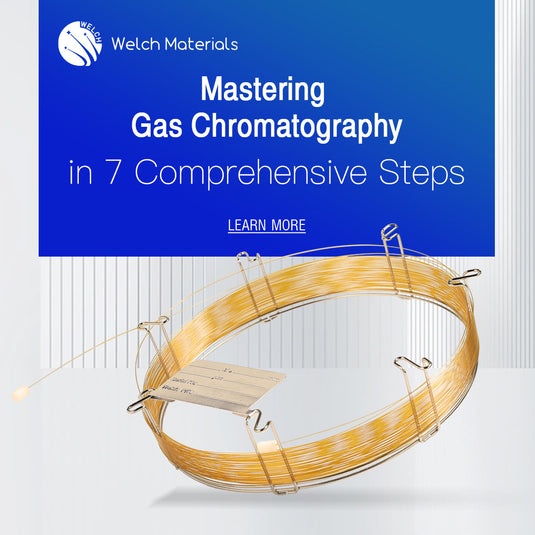

Mastering Gas Chromatography in 7 Comprehensive Steps!
This article guides analysts in GC analyses through efficient sample preparation, instrument configuration, initial condition setup, separation optimization, qualitative identification using retention indices or GC–MS, quantitative analysis via internal standards or standard addition, rigorous method validation, ensuring accurate, precise, reproducible results across diverse unknown sample analyses consistently.


![[Readers Insight] Matrix Effects in Mass Spectrometry: Why They Matter](http://www.welch-us.com/cdn/shop/articles/matrix-effect-2-1080-922_535x.jpg?v=1773718626)
![[Readers Insight] Matrix Effects in Mass Spectrometry: Why They Matter](http://www.welch-us.com/cdn/shop/articles/matrix-effect-2-1080-922_345x345@2x.jpg?v=1773718626)


![[Readers Insight] Acidic or Basic? Read Analyte Structure First When Developing a Method](http://www.welch-us.com/cdn/shop/articles/acidic-basic0911-1080_535x.jpg?v=1773718531)
![[Readers Insight] Acidic or Basic? Read Analyte Structure First When Developing a Method](http://www.welch-us.com/cdn/shop/articles/acidic-basic0911-1080_345x345@2x.jpg?v=1773718531)

![[Readers Insight] The Starting Point in Method Development](http://www.welch-us.com/cdn/shop/articles/starting-point-1080-822_66049d9e-9b96-49f0-b38f-d3efbb05bbb0_535x.jpg?v=1773718422)
![[Readers Insight] The Starting Point in Method Development](http://www.welch-us.com/cdn/shop/articles/starting-point-1080-822_66049d9e-9b96-49f0-b38f-d3efbb05bbb0_345x345@2x.jpg?v=1773718422)
![[Readers Insight] Are You Choosing the Right Quantifier Ion for Mass Spectrometry?](http://www.welch-us.com/cdn/shop/articles/quantifier-ion-1080-815_535x.jpg?v=1773718320)
![[Readers Insight] Are You Choosing the Right Quantifier Ion for Mass Spectrometry?](http://www.welch-us.com/cdn/shop/articles/quantifier-ion-1080-815_345x345@2x.jpg?v=1773718320)
![[Readers Insight] Become an “Engineer”, Instead of an “Inspector”](http://www.welch-us.com/cdn/shop/articles/engineer-1080-815_86849ee0-0b0f-42aa-bbc0-466b0754ef77_535x.jpg?v=1760000922)
![[Readers Insight] Become an “Engineer”, Instead of an “Inspector”](http://www.welch-us.com/cdn/shop/articles/engineer-1080-815_86849ee0-0b0f-42aa-bbc0-466b0754ef77_345x345@2x.jpg?v=1760000922)
![[Readers Insight] Why Do M-Shaped Peaks Occur?](http://www.welch-us.com/cdn/shop/articles/m-peak-1080-814_535x.webp?v=1773651099)
![[Readers Insight] Why Do M-Shaped Peaks Occur?](http://www.welch-us.com/cdn/shop/articles/m-peak-1080-814_345x345@2x.webp?v=1773651099)

