
Knowledge Base


-
![[Readers Insight] Heterocycles Structural Analysis in HPLC Method Development](//www.welch-us.com/cdn/shop/articles/heterocycles_535x.jpg?v=1773724415)
![[Readers Insight] Heterocycles Structural Analysis in HPLC Method Development](//www.welch-us.com/cdn/shop/articles/heterocycles_345x345@2x.jpg?v=1773724415)
[Readers Insight] Heterocycles Structural Analysis in HPLC Method Development
In this article, the author analyzes the structures of heterocycles (mostly aromatic heterocycles) and how the structures affect heterocycles' acid-base property. -
![[Readers Insight] Choose Methanol or Acetonitrile? The Organic Mobile Phase in HPLC](//www.welch-us.com/cdn/shop/articles/1080_7c636f0f-edc5-4f09-ae81-c57bf62ca14c_535x.jpg?v=1773724333)
![[Readers Insight] Choose Methanol or Acetonitrile? The Organic Mobile Phase in HPLC](//www.welch-us.com/cdn/shop/articles/1080_7c636f0f-edc5-4f09-ae81-c57bf62ca14c_345x345@2x.jpg?v=1773724333)
[Readers Insight] Choose Methanol or Acetonitrile? The Organic Mobile Phase in HPLC
In HPLC analysis, methanol and acetonitrile are the most common organic mobile phases. But have you ever thought about what exactly differentiates them? When should methanol be used and when acetonitrile? In this article, the author shares their thoughts on this matter. -
![[Readers Insight] Why Do Substances with Similar Polarity Dissolve in Each Other?](//www.welch-us.com/cdn/shop/articles/dissolve_535x.jpg?v=1773724307)
![[Readers Insight] Why Do Substances with Similar Polarity Dissolve in Each Other?](//www.welch-us.com/cdn/shop/articles/dissolve_345x345@2x.jpg?v=1773724307)
[Readers Insight] Why Do Substances with Similar Polarity Dissolve in Each Other?
In this article and attached video, the author discusses why substances with similar polarity dissolve in each other through dipole-dipole interactions, the energy change during dissolution, and the effect from entropy and Gibbs free energy. -
![[Readers Insight] Why Do Ghost Peaks Appear?](//www.welch-us.com/cdn/shop/articles/ghost-peak-1080-1029_97b7ea33-b337-4ee9-a749-66252df7cf0b_535x.jpg?v=1773724186)
![[Readers Insight] Why Do Ghost Peaks Appear?](//www.welch-us.com/cdn/shop/articles/ghost-peak-1080-1029_97b7ea33-b337-4ee9-a749-66252df7cf0b_345x345@2x.jpg?v=1773724186)
[Readers Insight] Why Do Ghost Peaks Appear?
In this article, we examine the common origins of ghost peaks in HPLC. From mobile phase contamination and instrument residues, to column impurities and sample-related degradation, the article explains how they contribute to the appearance of ghost peaks. -
![[Readers Insight] Is Retention Time Determined Solely by the Polarity of a Compound?](//www.welch-us.com/cdn/shop/articles/ret-time-1080-1027_535x.jpg?v=1773724051)
![[Readers Insight] Is Retention Time Determined Solely by the Polarity of a Compound?](//www.welch-us.com/cdn/shop/articles/ret-time-1080-1027_345x345@2x.jpg?v=1773724051)
[Readers Insight] Is Retention Time Determined Solely by the Polarity of a Compound?
Have you ever thought about this question: In reversed-phase chromatography, does an earlier elution always mean the compound has higher polarity? Or rather — is retention time determined solely by the polarity of a compound? In this article, we explore what polarity is, why it acts as the primary factor affecting retention time, and what other factors are unneglectable. -
![[Readers Insight] Mobile Phase Selection in Method Development: How to Optimize](//www.welch-us.com/cdn/shop/articles/mpoptimize-1080-1020_535x.jpg?v=1773723983)
![[Readers Insight] Mobile Phase Selection in Method Development: How to Optimize](//www.welch-us.com/cdn/shop/articles/mpoptimize-1080-1020_345x345@2x.jpg?v=1773723983)
[Readers Insight] Mobile Phase Selection in Method Development: How to Optimize
In method development, the selection of mobile phases is an important part to success. This article discusses thoroughly different mobile phases and their use in HPLC and LC-MS, and provides recommendations for initial mobile phase choices. -
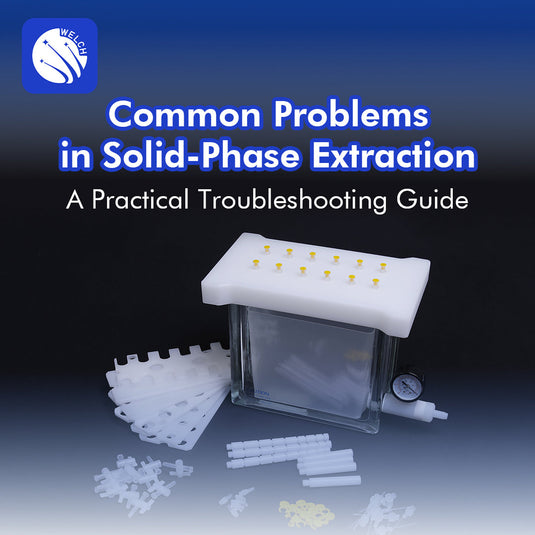

Common Problems in Solid-Phase Extraction: A Practical Troubleshooting Guide
Solid-Phase Extrtaction is a fast, easy and high-performance sample preparation technique widely used, but routine SPE runs can encounter recurring problems. This article summarizes typical causes and practical fixes for each SPE problem. -
![[Readers Insight] Retention Time Drifts: Why Do They Occur?](//www.welch-us.com/cdn/shop/articles/1080-1017-2_535x.jpg?v=1773718683)
![[Readers Insight] Retention Time Drifts: Why Do They Occur?](//www.welch-us.com/cdn/shop/articles/1080-1017-2_345x345@2x.jpg?v=1773718683)
[Readers Insight] Retention Time Drifts: Why Do They Occur?
Learn the causes of retention time drift in HPLC analyses, explained thoroughly through mobile phase, column, instrument, and sample solvent. -
![[Readers Insight] Matrix Effects in Mass Spectrometry: Why They Matter](//www.welch-us.com/cdn/shop/articles/matrix-effect-2-1080-922_535x.jpg?v=1773718626)
![[Readers Insight] Matrix Effects in Mass Spectrometry: Why They Matter](//www.welch-us.com/cdn/shop/articles/matrix-effect-2-1080-922_345x345@2x.jpg?v=1773718626)
[Readers Insight] Matrix Effects in Mass Spectrometry: Why They Matter
In this article, we explore further how matrix effects affects recovery results in mass spectrometry analyses by hindering preparation loss, and discuss when it should be corrected by using calibration curves prepared by blank matrices. -
![[Readers Insight] Acidic or Basic? Read Analyte Structure First When Developing a Method](//www.welch-us.com/cdn/shop/articles/acidic-basic0911-1080_535x.jpg?v=1773718531)
![[Readers Insight] Acidic or Basic? Read Analyte Structure First When Developing a Method](//www.welch-us.com/cdn/shop/articles/acidic-basic0911-1080_345x345@2x.jpg?v=1773718531)
[Readers Insight] Acidic or Basic? Read Analyte Structure First When Developing a Method
In this article, we discuss how to read molecular structure to assess an analyte’s acidic or basic character and use that insight to design starting chromatographic methods. You will find practical, rule-based criteria, clear decision points for method setup, and a focused real-world example that illustrates structure-driven choices. -
![[Readers Insight] The Starting Point in Method Development](//www.welch-us.com/cdn/shop/articles/starting-point-1080-822_66049d9e-9b96-49f0-b38f-d3efbb05bbb0_535x.jpg?v=1773718422)
![[Readers Insight] The Starting Point in Method Development](//www.welch-us.com/cdn/shop/articles/starting-point-1080-822_66049d9e-9b96-49f0-b38f-d3efbb05bbb0_345x345@2x.jpg?v=1773718422)
[Readers Insight] The Starting Point in Method Development
Method development often begins with uncertainty—especially when faced with unknown compounds and no literature guidance. This article examines a pharmacopoeial method as a case study, highlighting its chromatographic settings, analyzing potential limitations, and considering improvements. Through this, readers gain insight into the logical framework behind choosing starting conditions. -
![[Readers Insight] Are You Choosing the Right Quantifier Ion for Mass Spectrometry?](//www.welch-us.com/cdn/shop/articles/quantifier-ion-1080-815_535x.jpg?v=1773718320)
![[Readers Insight] Are You Choosing the Right Quantifier Ion for Mass Spectrometry?](//www.welch-us.com/cdn/shop/articles/quantifier-ion-1080-815_345x345@2x.jpg?v=1773718320)
[Readers Insight] Are You Choosing the Right Quantifier Ion for Mass Spectrometry?
In this article, the author discusses the principles behind selecting quantifier ions in triple quadrupole mass spectrometry, with a case study to illustrate how ion choice impacts sensitivity and accuracy.
![[Readers Insight] Heterocycles Structural Analysis in HPLC Method Development](http://www.welch-us.com/cdn/shop/articles/heterocycles_535x.jpg?v=1773724415)
![[Readers Insight] Heterocycles Structural Analysis in HPLC Method Development](http://www.welch-us.com/cdn/shop/articles/heterocycles_345x345@2x.jpg?v=1773724415)
![[Readers Insight] Choose Methanol or Acetonitrile? The Organic Mobile Phase in HPLC](http://www.welch-us.com/cdn/shop/articles/1080_7c636f0f-edc5-4f09-ae81-c57bf62ca14c_535x.jpg?v=1773724333)
![[Readers Insight] Choose Methanol or Acetonitrile? The Organic Mobile Phase in HPLC](http://www.welch-us.com/cdn/shop/articles/1080_7c636f0f-edc5-4f09-ae81-c57bf62ca14c_345x345@2x.jpg?v=1773724333)
![[Readers Insight] Why Do Substances with Similar Polarity Dissolve in Each Other?](http://www.welch-us.com/cdn/shop/articles/dissolve_535x.jpg?v=1773724307)
![[Readers Insight] Why Do Substances with Similar Polarity Dissolve in Each Other?](http://www.welch-us.com/cdn/shop/articles/dissolve_345x345@2x.jpg?v=1773724307)
![[Readers Insight] Why Do Ghost Peaks Appear?](http://www.welch-us.com/cdn/shop/articles/ghost-peak-1080-1029_97b7ea33-b337-4ee9-a749-66252df7cf0b_535x.jpg?v=1773724186)
![[Readers Insight] Why Do Ghost Peaks Appear?](http://www.welch-us.com/cdn/shop/articles/ghost-peak-1080-1029_97b7ea33-b337-4ee9-a749-66252df7cf0b_345x345@2x.jpg?v=1773724186)
![[Readers Insight] Is Retention Time Determined Solely by the Polarity of a Compound?](http://www.welch-us.com/cdn/shop/articles/ret-time-1080-1027_535x.jpg?v=1773724051)
![[Readers Insight] Is Retention Time Determined Solely by the Polarity of a Compound?](http://www.welch-us.com/cdn/shop/articles/ret-time-1080-1027_345x345@2x.jpg?v=1773724051)
![[Readers Insight] Mobile Phase Selection in Method Development: How to Optimize](http://www.welch-us.com/cdn/shop/articles/mpoptimize-1080-1020_535x.jpg?v=1773723983)
![[Readers Insight] Mobile Phase Selection in Method Development: How to Optimize](http://www.welch-us.com/cdn/shop/articles/mpoptimize-1080-1020_345x345@2x.jpg?v=1773723983)

![[Readers Insight] Retention Time Drifts: Why Do They Occur?](http://www.welch-us.com/cdn/shop/articles/1080-1017-2_535x.jpg?v=1773718683)
![[Readers Insight] Retention Time Drifts: Why Do They Occur?](http://www.welch-us.com/cdn/shop/articles/1080-1017-2_345x345@2x.jpg?v=1773718683)
![[Readers Insight] Matrix Effects in Mass Spectrometry: Why They Matter](http://www.welch-us.com/cdn/shop/articles/matrix-effect-2-1080-922_535x.jpg?v=1773718626)
![[Readers Insight] Matrix Effects in Mass Spectrometry: Why They Matter](http://www.welch-us.com/cdn/shop/articles/matrix-effect-2-1080-922_345x345@2x.jpg?v=1773718626)
![[Readers Insight] Acidic or Basic? Read Analyte Structure First When Developing a Method](http://www.welch-us.com/cdn/shop/articles/acidic-basic0911-1080_535x.jpg?v=1773718531)
![[Readers Insight] Acidic or Basic? Read Analyte Structure First When Developing a Method](http://www.welch-us.com/cdn/shop/articles/acidic-basic0911-1080_345x345@2x.jpg?v=1773718531)
![[Readers Insight] The Starting Point in Method Development](http://www.welch-us.com/cdn/shop/articles/starting-point-1080-822_66049d9e-9b96-49f0-b38f-d3efbb05bbb0_535x.jpg?v=1773718422)
![[Readers Insight] The Starting Point in Method Development](http://www.welch-us.com/cdn/shop/articles/starting-point-1080-822_66049d9e-9b96-49f0-b38f-d3efbb05bbb0_345x345@2x.jpg?v=1773718422)
![[Readers Insight] Are You Choosing the Right Quantifier Ion for Mass Spectrometry?](http://www.welch-us.com/cdn/shop/articles/quantifier-ion-1080-815_535x.jpg?v=1773718320)
![[Readers Insight] Are You Choosing the Right Quantifier Ion for Mass Spectrometry?](http://www.welch-us.com/cdn/shop/articles/quantifier-ion-1080-815_345x345@2x.jpg?v=1773718320)